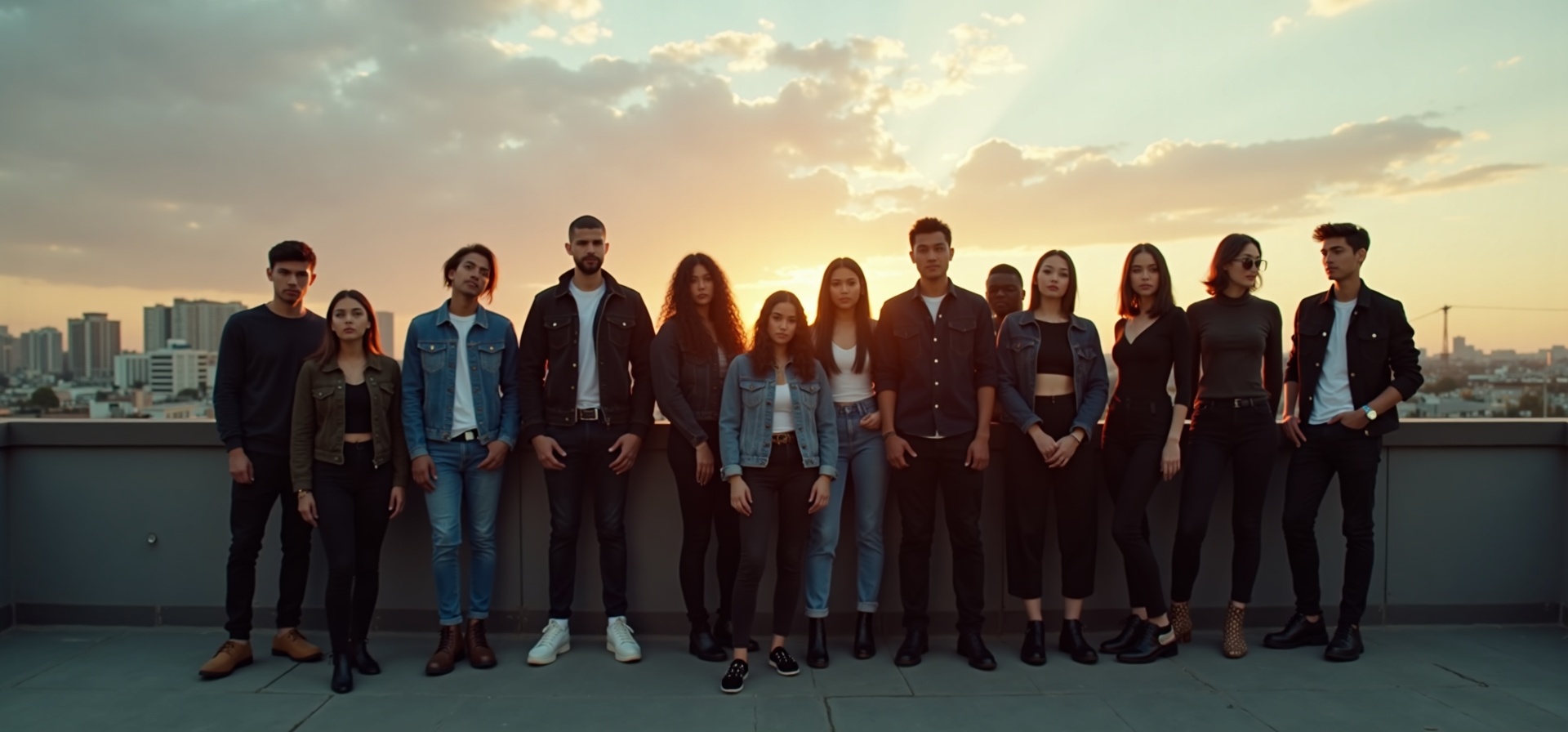
Middle Finger — Our Story

The Full Story

Our Story

Est. 2020 — Lagos & Beyond

“We didn't start a brand.
We started a refusal.”

— Middle Finger, 2020
01

The Beginning

It Started as a Protest

Middle Finger was never supposed to be a brand. It was supposed to be a statement.

In 2020, during a year the world spent largely frozen — locked in, locked down, locked out of itself — three people sat in a cramped Lagos apartment surrounded by bolts of raw denim, a second-hand sewing machine, and a shared fury at an industry that kept telling them what to wear, how to look, and who they were allowed to be.

They weren't fashion insiders. They weren't backed by investors. They had no PR firm, no influencer budget, no mood board blessed by a creative director with a hyphenated title. What they had was a name that made people uncomfortable, a refusal to explain it, and a denim jacket that fit like it was stitched directly onto your attitude.

The name was never an accident. Middle Finger is exactly what it sounds like — a raised hand aimed at every gatekeeper, every trend committee, every fast-fashion machine churning out sameness at scale. Not anger for anger's sake. Clarity. The kind of clarity you only get when you've finally stopped pretending to care about what the wrong people think.

02

The Denim

Why Denim? Because Denim Remembers.

Denim was the choice because denim is honest. It doesn't perform. It doesn't fake it. You wear denim for a decade and it becomes a map of every place you've been, every fight you've had, every night you stayed out too late. Other fabrics want to look new. Denim earns its story.

From day one, the brand committed to denim as its primary language — not as a trend, not as a category, but as a philosophy. Every wash tells a different story. Every tear is intentional. Every silhouette is obsessed over until it feels less like clothing and more like a second skin.

The first collection was nine pieces. A jacket. Three pairs of jeans cut in silhouettes nobody was cutting. Two overshirts. A denim bucket hat that somehow ended up on four different album covers before the year was out. And two accessories — a belt and a tote — both stamped simply with the two-word name that had made every retailer they'd pitched nervous to carry it.

They sold out in eleven days. Through Instagram DMs and a basic Shopify store. No stockists. No wholesale. No press. Just people who felt it — who saw the name and thought: yeah, that's me.

03

The Refusal

Every Door They Shut, We Didn't Need.

The rejection letters were plentiful. High-end department stores passed — "the branding is too aggressive." Mainstream stockists wanted them to change the name — "just to something a little more neutral, more commercial." One buyer at a well-known European retailer told them the logo was "untenable for family shoppers."

They declined every compromise. Not out of stubbornness — out of conviction. The name wasn't a provocation for its own sake. It was a filter. A way of asking: are you actually for us, or are you just mildly curious?

The community that found them through those early refusals became the bedrock of everything. These weren't passive consumers. They were advocates, co-conspirators almost — people who felt the brand spoke *for* them in a way most brands never had. Youth culture. Street culture. People who moved between cities and sounds and scenes and didn't fit neatly into any demographic a focus group had ever mapped.

By the end of 2021, Middle Finger had shipped to 40 countries. Still no stockists. Still no name change.

04

The Culture

Not a Brand That Talks About Culture. A Brand That Is One.

Fashion has a habit of borrowing from subcultures without ever belonging to them. Middle Finger was different from the start because the people building it were the culture — not observers, not anthropologists, not trend forecasters. They were in it.

Every collection has been a direct conversation with the world the brand lives inside. The music coming out of Lagos, Accra, London, New York, Berlin. The street art scenes. The skate parks. The underground club nights. The designers and painters and photographers and DJs who make culture without waiting for permission from anyone.

Collaborations have always been with artists first, brands second. A capsule with a Johannesburg painter. A limited run designed alongside a British-Nigerian sculptor. A drop tied to a music release from an artist the brand had followed since before either of them had broken through. These weren't marketing moves — they were genuine creative relationships, born from mutual respect and a shared point of view.

The aesthetic is urban. It's global. It's rooted in African energy and street culture simultaneously — not because that's a marketable intersection, but because that's the lived reality of the people who made it.

05

The Growth

200,000 People Who Get It.

By 2023, the numbers had become impossible to ignore — not that Middle Finger was ever in the business of performing growth for growth's sake. But the scale of what had been built in silence was significant.

Over 200,000 people across more than 80 countries wearing the brand. Not because an algorithm pushed it to them. Not because a celebrity was paid to hold it. Because someone they trusted — a friend, a musician, a person they'd been watching for years — was wearing it and meant it.

The community became the marketing. Still does. When a new collection drops, it moves through word of mouth the way music moves. Not virality for its own sake — resonance. The kind of sharing that happens when something actually means something to the person sharing it.

The brand expanded its categories — extending beyond denim into tailoring, accessories, footwear — but always with the same filter: does this piece have an attitude? Does it feel like it was made for someone who knows exactly who they are? If the answer is no, it doesn't exist.

06

The Future

We're Not Done Making People Uncomfortable.

Middle Finger isn't a legacy brand doing a streetwear capsule. It isn't a streetwear brand doing luxury. It isn't trying to grow into something more acceptable, more palatable, more retail-friendly. It is exactly what it was on day one — just louder, wider, and sharper.

The roadmap ahead includes everything: flagship physical spaces that feel like galleries and act like community hubs. Global collaborations with artists who don't yet have the platform they deserve. A commitment to production practices that match the brand's values — sustainable sourcing, fair labour, zero apology about what things cost to make properly.

There will be new categories. New chapters. New collections that will divide opinion and unite the people who matter. There will be more doors that choose not to open — and more doors we choose not to knock on.

The name will never change. The attitude will never soften. The only thing that grows is the scale at which we say it.

Middle Finger. For everyone who was never interested in blending in.

Middle Finger

For everyone who was never interested in blending in.

The name hasn't changed. The attitude hasn't softened. And we're only just getting started.